
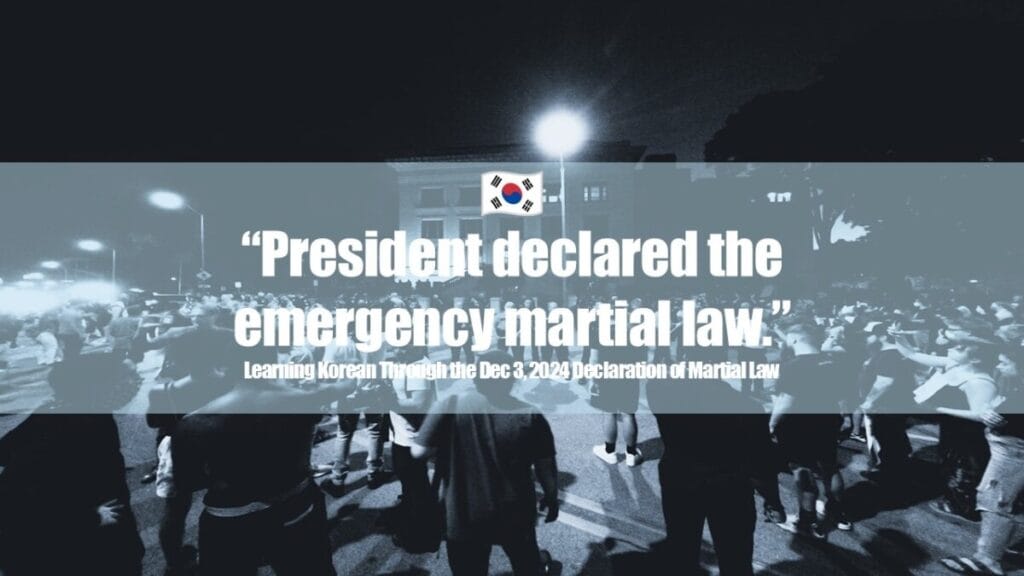
On December 3, 2024, President Yoon declared martial law. I was in Mexico on a trip that day, and when I woke up in the morning and read the news, I was shocked. This event sparked much controversy and attracted significant attention both in South Korea and internationally. In this post, we will learn important Korean expressions related to this issue and explore how to use the Korean language in the context of martial law.
The Republic of Korea is a free democracy.
The Republic of Korea is a free democracy.
대한민국은 자유 민주주의 국가이다.
[dae-han-min-gu-geun-ja-yoo-min-ju-ju-ui-guk-gga-i-da]
대한민국 [Dae-han-min-guk] is the official name of Republic of Korea. “대한[Dae-han]” means “great” or “large,” and “민국[min-guk]” refers to “nation” and “people.” Therefore, “대한민국” translates to “The Republic of the Great Nation.”
자유 민주주의[Ja-yoo-min-ju-ju-ui] means Liberal Democracy. It refers to a political system where people have the freedom to express their opinions, vote, and participate in governing the country. In a 자유 민주주의 system, fundamental rights, such as freedom of speech, right to a fair trial, and voting rights, are guaranteed.
The character “의” should be pronounced as “ui,” but in reality, Koreans tend to pronounce it closer to “i.”
Opposite expression is 독재[dok-jae] which refers to dictatorship. Under dictatorship, one person or a group holds absolute power, often without the consent of the governed people, restricting their freedoms.
President declared the emergency martial law.
President declared the emergency martial law.
대통령은 비상 계엄령을 선포했다.
[dae-tong-ryeong-eun-bi-sang-ge-eom-ryeong-eul-seon-po-hae-dda]
계엄령[ge-eom-ryeong] refers to martial law, which is a state of emergency in which the military is given control over civilian areas. It is typically declared during times of national crisis or unrest. Civil liberties are restricted, and military authority is extended over civilian life. This means that ordinary legal processes, such as the judicial system, may be suspended, and the military can enforce laws and maintain order.
President announced that he would lift the emergency martial law declaration.
President announced that he would lift the emergency martial law declaration.
대통령은 비상 계엄령 선포를 해제할 것이라고 발표했다.
[dae-tong-ryeong-eun-bi-sang-ge-eom-ryeong-seon-po-reul-hae-je-hal-geo-si-ra-go-bal-pyo-hae-dda]
“해제[hae-je]” means repeal or lift. It refers to removing or discontinuing a regulation or restriction. For example, 계엄령 해제 [gye-eom-ryeong-hae-je] means lifting martial law and returning to civilian control.
발표[bal-pyo] means announce or declare. It refers to formally making information public or declaring something officially.
People take part in a protest calling for the ouster of president.
People take part in a protest calling for the ouster of president.
사람들은 대통령의 퇴진을 요구하는 시위에 참여하고 있다.
[sa-ram-deu-reun-dae-tong-ryeong-ui-toe-ji-neul-yo-gu-ha-neun-si-wi-e-cham-yeo-ha-go-it-dda]
퇴진[toe-jin] means resignation. 퇴진 refers to when a political leader or official steps down from their position, usually due to pressure or scandal. For example, when a president decides to leave office in the face of a political crisis, it is called 퇴진.
요구[yo-gu] means demand or request. It refers to the act of strongly requesting or urging something to happen.
시위[si-wi] means protest or demonstration. A 시위 is a collective public event where people express opposition or dissatisfaction with a government policy or action.
There will be a vote on whether to impeach president.
There will be a vote on whether to impeach president.
대통령을 탄핵할 지 여부에 대한 투표가 있을 것이다.
[dae-tong-ryeong-eul-tan-haek-hal-ji-yeo-bu-e-dae-han-tu-pyo-ga-it-sseul-geo-si-da]
탄핵[tan-haek] means impeachment. 탄핵 is the formal process of removing a public official from office for misconduct, failure to perform duties, or breaking the law. This process is usually carried out by the legislature.
여부[yeo-bu] means whether or not. This expression indicates uncertainty about whether something will happen or not.
투표 [tu-pyo] means vote. A 투표 is a formal procedure where individuals express their opinions or make a decision about a matter. In the case of impeachment, a 투표 would decide whether to remove an official from office.
In this post, we have explained key political terms in Korean, such as 대한민국 (Republic of Korea), 자유 민주주의 (Liberal democracy), 계엄령 (Martial law), 퇴진 (Resignation), and 탄핵 (Impeachment). Understanding these expressions will help you gain a better understanding of political discussions in South Korea and improve your Korean language skills related to political topics.
If you’re interested in more useful Korean expressions, check out our previous posts. : Korean Slang 5 Trending Words